Contents
You’ve got water on the floor, a wet wall, maybe a ceiling stain that showed up overnight. One of the first things everybody asks us is, “Is my insurance going to cover this?”
The honest answer is that it depends on your policy and on how the water got there. We can’t promise what your insurance will pay. That’s between you and your carrier. What we can do is tell you what we see Florida insurance companies push back on, so you’re not caught off guard.
Here’s what we’ve learned working water claims across Brevard County.
Don’t sit on a leak: the 14-day rule
Many policies exclude leaks that have been going on for 14 days or more. So long-term damage usually gets denied. A burst supply line you catch the same day is a very different claim than a slow drip under the sink that’s been soaking the cabinet for months.
That’s why it pays to catch the small stuff early. When we inspect a home, these are the signs we look for:
- Cabinets swelling at the bottom
- Baseboards pulling away from the wall
- Bubbling paint under windows
- Water stains on the ceiling
- Condensation on your AC vents
If you see any of these, don’t wait on it. Find the source, get it fixed, and get it looked at. Here’s what to do right after water damage, and the mistakes that make it worse.
The $3,000 cap on water mitigation
A lot of policies now cap water mitigation at $3,000. Mitigation is the part we do: extracting the water, pulling wet materials, and drying the house out.
That cap puts homeowners in a tight spot, because a medium water job, like a few bedrooms and a bathroom or a kitchen and living room, runs $3,000 to $8,000. A small job like a bathroom is usually $1,700 to $2,000. Every job is different, so those are ranges, not quotes. Here’s more on what water damage restoration costs in Brevard.
Every job starts with a free moisture evaluation, and you’ll know roughly what it costs before we start. Nothing starts until you sign off.
Mold usually needs a water claim
Most policies only cover mold that comes from a covered water loss. The water claim is what opens up the mold coverage in your policy, and most people don’t know that.
This matters because mold can start growing within 24 to 48 hours of a leak. When a kitchen, bathroom, laundry room or AC closet leaks and there’s water on the floor, most homeowners mop up what they can see. What they don’t know is that most of the moisture has already wicked up into the drywall and other building materials. If that never gets dried out properly, it can turn into a mold job down the road.
How payment works with us
We take a deposit before every job starts. Sometimes it’s 50% of the job, sometimes it’s your deductible. We contract directly with you, the homeowner, so at the end of the day the bill is yours, even if your insurance company doesn’t pay for some reason. That’s the hard truth.
Normally the insurance company pays you and you pay us, or you pay us and get reimbursed for the completed work.
Why do we work this way? In our experience, insurance companies want to negotiate every job down, no matter how fair the price is. Working directly for you means the job gets done right instead of to the insurer’s budget.
Should you call your insurance company first?
Most of our customers call their insurance company first, just to confirm their coverage and that they can choose who does the mitigation. That’s where a lot of people go wrong. The insurance company will usually try to send its preferred vendor, a company that works for them, not you.
We’ve never worked for an insurance company, and we’ve never been on any insurer’s preferred vendor list. We work for you directly. You’re our customer, and we always try to keep your best interest in mind.
How we back up your claim
We document everything the way insurance companies want it, and on insurance claims we write our estimates in Xactimate, the same software their adjusters use. We can’t promise what your insurance will pay, but our documentation is built to back up your claim. More on that on our insurance claim documentation page.
Here’s what that looks like on a job:
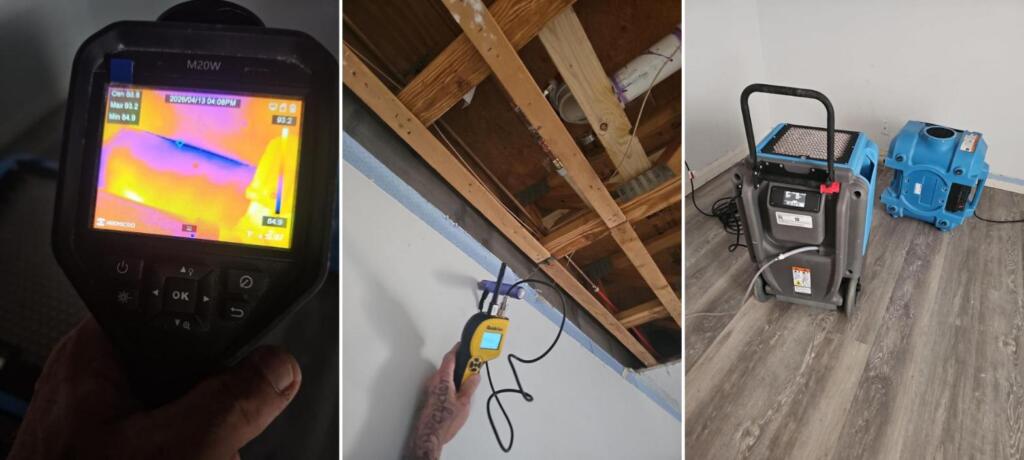
- Thermal imaging and moisture meters on the first visit, so we know where the water went and how much is in the materials.
- A “dry standard” reading from a wall the water never touched. That’s the number we dry the rest of your house back to, not a made-up number.
- Moisture readings on every visit while the equipment runs, until everything’s back to that dry standard.
- A full water package when we’re done: the moisture readings from your project, all the photos and documentation we took along the way, the estimate, and the invoice.
On most of our insurance claims, we also refer a public adjuster to help our customer get everything their policy covers and recover as much as possible from the insurance company, so they have the money to rebuild their home properly.
Quick answers
Does homeowners insurance cover water damage in Florida? It depends on your policy and how the damage happened. Long-term leaks usually get denied, and a lot of policies cap mitigation. Every policy is different, so check yours or ask your agent.
Does insurance cover mold? Most policies only cover mold that comes from a covered water loss. The water claim is what opens up the mold coverage.
What if my insurance doesn’t pay? We contract directly with you, so the bill is yours either way. We document everything to back up your claim, and on most claims we refer a public adjuster.
Can I pick my own restoration company? Call your insurance company to confirm your coverage and that you can choose who does the mitigation. They’ll usually try to send their preferred vendor, but that company works for them, not you.
Why Brevard homeowners call us
We’re a small-town company, and we’re proud of our Brevard roots. We treat our customers like family, not like a number, and we take care of every home like it’s our own. We’ve never worked for an insurance company. On a claim, we work for you, the homeowner, because working for the insurer too would be a conflict of interest. We aim to do it right the first time, so you shouldn’t need to call us back unless something new happens. And honestly, we just like making a bad day a little better, even if it’s only by lending a hand.
Dealing with a leak and not sure where your claim stands? Call Affordable Water and Mold Removal at (321) 890-2512 for a free moisture evaluation. We serve all of Brevard County, from Mims to Palm Bay and the beaches.
About the author: Daniel Ryan Townsend grew up in Port St. John and has spent 15+ years in the restoration field, starting in his early twenties as a helper for a Brevard County restoration company. He worked his way up from technician to lead tech, supervisor, and management, then opened Affordable Water and Mold Removal in March 2018. He has been IICRC certified for 10+ years and holds the WRT (water damage restoration) and AMRT (mold remediation) certifications, plus Florida mold remediator license MRSR3317.
Recent Posts
What Causes Most Water Damage in Brevard County Homes
AC drain overflows, supply lines, slab leaks and backed-up drains. A Brevard restoration owner on the leaks we see most and how to catch them early.
Mold Behind the Kitchen Cabinets: A Titusville Drain Leak Job, Start to Finish
A slow drain leak under a Titusville kitchen sink turned into mold behind the cabinets and wall. Here is how the job ran, with photos, from containment to hand-off.
Found Mold After a Leak in Florida? Who to Call First
Found mold after a leak? Here is who to call, in what order, and why Florida keeps the mold assessor and the mold remediator separate on the same job.