Contents
Most of the water damage calls we get don’t start with a hurricane. They start with something small inside the house that nobody was watching: a drain line in the AC closet, a plastic hose behind the toilet, a pipe under the slab.
We dry out homes from Mims to Palm Bay and the beaches, and we see the same handful of causes over and over. Knowing what they are won’t stop every leak. But it’ll help you catch one early, before a small leak turns into a big job.
Here’s what we see most around here, and what you can do about each one.
1. AC units backing up and overflowing
This is the most common one we see in Florida. Your AC pulls a lot of water out of the air here, and all of it has to go out through the drain line. When that line backs up, the water ends up on the floor of the AC closet, in the wall behind it, and in whatever room is on the other side.
AC closets are one of the wet areas of the house where we see leaks that were never handled properly turn into mold jobs later. A homeowner mops up the water they can see, but most of the moisture has already wicked up into the drywall.
What helps: get your AC serviced regularly, including a cleaning of the drain system. The AC itself is a job for a licensed HVAC company. We handle the water damage. If you don’t already have an HVAC company you’re happy with, we’ll refer you to the one we work with every day.
One more AC problem we’ve been seeing more of lately: vents that sweat. That condensation usually means the vent isn’t sealed to the drywall, or the humidity in the house is too high. Left alone, it normally leads to mold.
2. Supply lines to sinks, toilets, washers, dishwashers and fridges
Every one of these has a water supply line, and some of those lines are plastic. A supply line is under pressure, so when one lets go, it doesn’t drip. It keeps running until somebody shuts the water off.
What helps: take a look behind your toilets, under your sinks, and behind the washer, dishwasher and fridge. Stainless braided lines are a better option for preventing leaks. And know where your main shutoff is before you need it. If a line bursts, shutting the water off at the main is the first thing to do, if you can do it safely. We cover the rest in what to do right after water damage.
3. Slab leaks
Slab leaks are very common in older homes. The water comes up from under the house, so it often goes a while before anyone sees it.
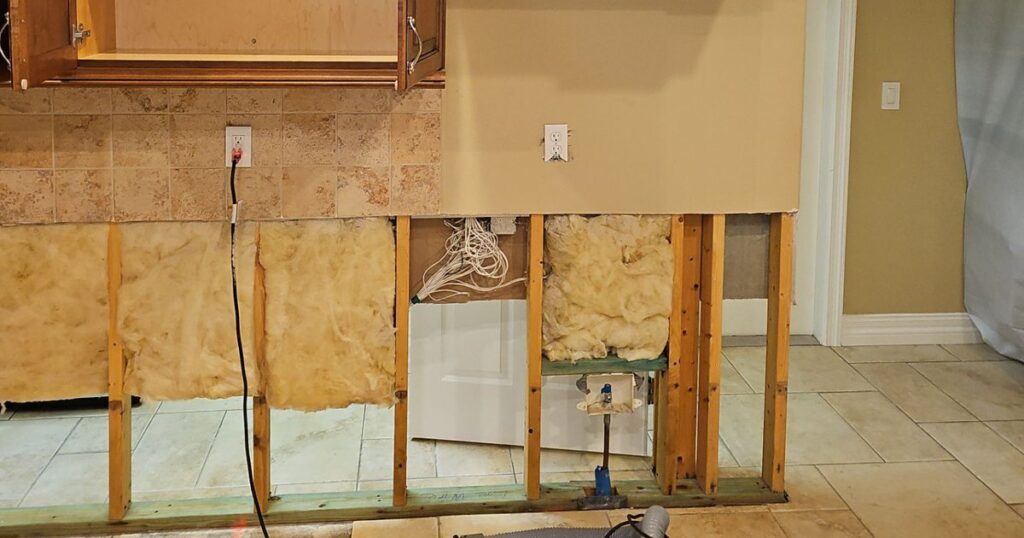
By the time it shows, it’s usually under the flooring. Everybody thinks tile is waterproof, but if water gets underneath it, the only way to dry the slab is to pull the tile so the concrete can release the moisture. The bottom plate of the wall sits right on that same slab, which makes it one of the hardest spots in a house to dry.
The leak itself is a plumber’s job. If it’s still leaking when we get there, we shut the water off at the main and help you find a trusted local plumber. Then we dry out the house.
4. Backed-up drains and toilet overflows
These are the ones where the type of water matters most. A washing machine or dishwasher overflow is gray water. Any water from a toilet bowl, and anything backing up from a drain line or the sewer, is black water. Neither one gets dried in place.
On gray and black water we do a flood cut, removing the bottom 2 or 4 feet of drywall depending on how high the water has wicked up the wall. We treat with antimicrobial multiple times, before and after removal. And we don’t run fans on those jobs at all, just dehumidifiers and air scrubbers, because blowing air across contaminated, wet materials spreads bacteria through the air in your home. More on that in gray and black water: why we cut drywall and never use fans.
5. Water from outside: windows, stucco and roofs
Not every leak starts with plumbing. We’ve been seeing a lot of windows and stucco cracks leak from our heavy wind-driven rain. The area gets wet a little at a time over a long stretch, and it doesn’t show itself until it’s a bigger problem.
Roof leaks usually come down to flashing that was installed wrong, or new flashing that never got installed when a new roof went on. If the roof is still dripping when we get there, we get buckets under the drips, start extracting water, and help you find a reputable local roofer with emergency service to patch it or make a temporary repair.
Signs you might be walking past
A lot of these leaks are slow, and slow leaks are the expensive ones. When we inspect a home, these are the things we look for:
- Cabinets swelling at the bottom
- Baseboards pulling away from the wall
- Bubbling paint under windows
- Water stains on the ceiling
- Condensation on your AC vents
If you see one of these, don’t sit on it. Mold can start growing within 24 to 48 hours of a leak. And many insurance policies exclude leaks that have been going on for 14 days or more, so long-term damage usually gets denied. Every policy is different, so check yours or ask your agent what’s covered.
You don’t have to guess how far the water went, either. On a free moisture evaluation, we use thermal imaging cameras to see where the water traveled and moisture meters to tell us how much is in the materials. Then you’ll know what you’re dealing with and roughly what it’ll cost before anything starts.
Quick answers
What’s the most common cause of water damage in Florida homes? AC units backing up and overflowing. Get your AC serviced regularly, including a cleaning of the drain system.
Are braided supply lines better than plastic? Stainless braided lines are a better option for preventing leaks on sinks, toilets, washers, dishwashers and fridges.
Will insurance cover a leak that’s been going on a while? Many policies exclude leaks that have been going on for 14 days or more. Every policy is different, so check yours or ask your agent.
Should I open the windows to help it dry? No. Outside humidity here usually runs 60 to 80%. Keep everything closed and let your AC run. It pulls moisture out of the air better than outside air ever will.
Why Brevard homeowners call us
We’re a small-town company, and we’re proud of our Brevard roots. We treat our customers like family, not like a number, and we take care of every home like it’s our own. We’ve never worked for an insurance company. On a claim, we work for you, the homeowner, because working for the insurer too would be a conflict of interest. We aim to do it right the first time, so you shouldn’t need to call us back unless something new happens. And honestly, we just like making a bad day a little better, even if it’s only by lending a hand.
Call Affordable Water and Mold Removal at (321) 890-2512 for a free moisture evaluation. We serve all of Brevard County, from Mims to Palm Bay and the beaches.
About the author: Daniel Ryan Townsend grew up in Port St. John and has spent 15+ years in the restoration field, starting in his early twenties as a helper for a Brevard County restoration company. He worked his way up from technician to lead tech, supervisor, and management, then opened Affordable Water and Mold Removal in March 2018. He has been IICRC certified for 10+ years and holds the WRT (water damage restoration) and AMRT (mold remediation) certifications, plus Florida mold remediator license MRSR3317.
Recent Posts
Will Insurance Cover Your Water Damage in Florida?
What Florida policies often push back on after a leak (the 14-day rule, $3,000 mitigation caps, mold) and how we back up your Brevard claim.
Mold Behind the Kitchen Cabinets: A Titusville Drain Leak Job, Start to Finish
A slow drain leak under a Titusville kitchen sink turned into mold behind the cabinets and wall. Here is how the job ran, with photos, from containment to hand-off.
Found Mold After a Leak in Florida? Who to Call First
Found mold after a leak? Here is who to call, in what order, and why Florida keeps the mold assessor and the mold remediator separate on the same job.