
Most of the mold and water calls we get from Cocoa Beach and Cape Canaveral have something in common: the owner is somewhere else. A snowbird in Ohio. A landlord with a rental between guests. A family that uses the condo six weekends a year. A cruise passenger who parked the car at the port and came back to a wet unit. This page is written for that owner. It covers what goes wrong in condos and second homes along this stretch of A1A, who is responsible for which part of it, and how we run a job when the person paying for it is on the other end of a phone.
Affordable Water and Mold Removal is in Cocoa, fifteen to twenty minutes over the 520 causeway. Florida-licensed mold remediator MRSR3317; the inspection is free. Call or text (321) 890-2512, Monday through Friday, 8 to 5.
The two ways a vacant unit grows mold
In a house that’s lived in, mold usually needs a leak. In a condo that sits empty, it doesn’t.
The A/C gets turned off. A Cocoa Beach owner came back to her seasonal condo on North Atlantic to find the air conditioning had been switched off, accidentally, for the summer. Mold had grown on nearly every surface: furniture, clothing, cabinets, walls. There was no leak anywhere. Months of 80-percent humidity in a sealed box did it alone. We worked through the unit salvaging what could be cleaned, removing what couldn’t, and doing a full particulate cleaning of every surface so the air and the contents were clean, not just the walls. The unit came back; a lot of the belongings didn’t.
A small thing leaks for a long time. In Cape Canaveral, a refrigerator’s water-line fitting let go while the homeowner was out of town. It ran until someone noticed. By then the water had reached the living room, dining room, hallway, kitchen, a bedroom and the guest bath; only the master bath and closet were dry. That became a full job: flooring out, lower kitchen cabinets out, baseboards off, a two-foot flood cut through every affected wall, antimicrobial on everything, a fine-particulate cleaning, four days of drying, and then a mold clearance by an independent assessor before the owner could start putting it back together. A quarter-turn valve behind a refrigerator would have cost a dollar.
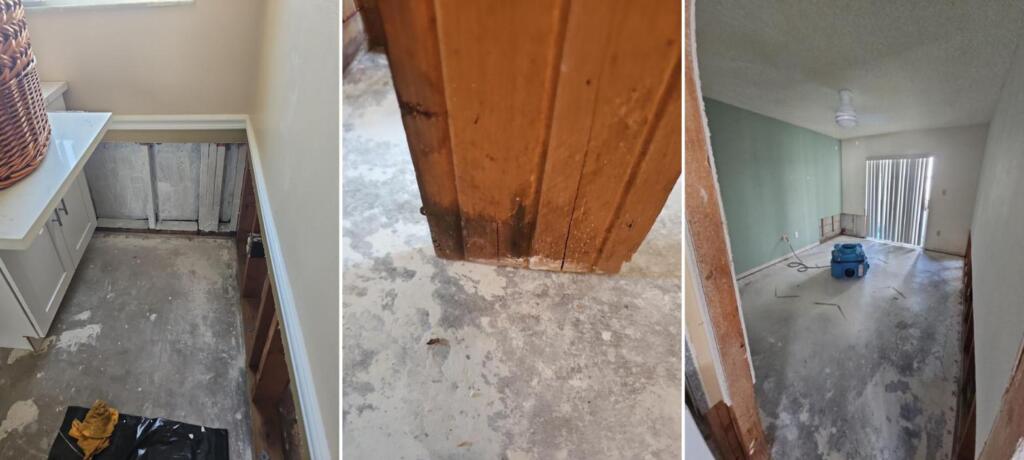
Mold in Cocoa Beach almost always starts with water. If you have an active leak, a wet wall or flooding, our Cocoa Beach water damage restoration team dries the structure first, then we handle the mold as part of the same job.
Who’s responsible for what in a condo
In a single-family house there’s one owner and one insurance policy. In a condo on A1A there are at least three parties, and the water doesn’t care about any of them.
You are generally responsible for everything inside your unit’s walls: your drywall, flooring, cabinets, fixtures and contents, and the water that comes from your fixtures. If your supply line bursts, the damage in your unit is yours, and so, usually, is the damage it causes below.
Your neighbors become part of it the moment water goes through a floor. On a Cocoa Beach job, a toilet supply line burst on the seventh floor of a condominium on North Atlantic. The water went down through all seven floors. One failed fitting, seven owners, seven policies, and one association, all needing the same thing: a clear record of where the water went and how far. We metered and documented every affected unit so that the conversation among the carriers was about numbers, not opinions.
The association typically owns the structure: the slab, the exterior walls, the roof, the common plumbing risers and drains between units. If the water came from a riser or from the roof, that’s usually the association’s loss, and its carrier gets involved. The association also controls access, elevators, parking for a trailer, and the hours work can happen. We’ve done enough of these buildings to know to call the manager before we call the elevator.
Our job in all of this is to be the one party with no stake in whose fault it is. We find the water, measure it, photograph it, dry it, and hand everyone the same report.
Running a job for an owner who’s out of state
You don’t need to fly in. Here’s how we handle it when you can’t be here:
- Someone local lets us in. A neighbor, the manager, a lockbox, a smart lock. We’ll coordinate directly with whoever that is.
- You get the photos the same day. Every reading, every wall we open, every piece of equipment we place, with the date on it. You see what we see.
- The estimate is written before we start. Xactimate, the same format your adjuster uses, emailed to you. You approve it from wherever you are.
- Daily drying logs. A short note each day with the readings, so you know when it’s done rather than guessing.
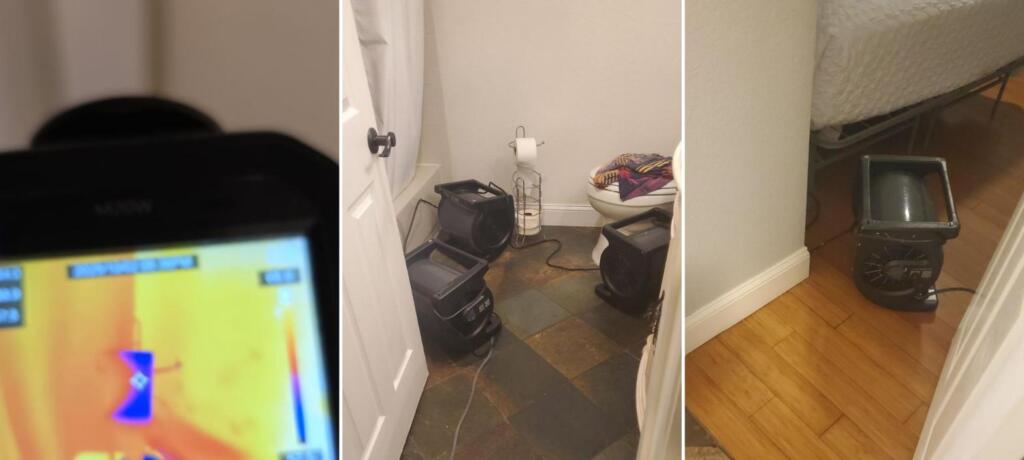
- We document for the claim and work for you. On a Cape Canaveral condo call where a significant leak needed an emergency response, we were there in half an hour, got the thermal camera on it, set up demolition and drying, built the claim file, and connected the owner with a public adjuster and contractors for the rebuild side, because he was managing all of it from a distance.
- Contents get a verdict, not a shrug. In the humidity-only jobs especially, you need to know what can be cleaned and what’s gone. We’ll tell you item by item.
Vacation rentals: between guests is when it happens
Short-term rentals in Cocoa Beach are their own case. Guests don’t report a slow drip. Cleaners are in and out in two hours. Nobody opens the water heater closet. On a Cocoa Beach vacation home, an A/C drain line backed up and ran unnoticed between bookings; by the time it was found the water damage was extensive and the mold growth was, in the technician’s word on the job sheet, extreme. For rental owners we recommend two things: a water leak sensor with a phone alert under every sink, behind the toilets and at the air handler, and a line in the cleaner’s checklist that says open the A/C closet and look at the drain pan.
When something does happen, we understand the calendar matters. We’ll tell you up front how many nights the unit is realistically out of service, and we’ll tell you if it’s fewer than you fear. Not every call is a gut: a Cocoa Beach condo owner had us check around a bedroom and the water heater closet, and a whole-unit thermal and meter survey of another condo gave its owner a clean map of where moisture was and wasn’t before any repairs were planned.
And sometimes the answer is “you don’t have a mold problem”
A Cape Canaveral homeowner had already had another local mold assessor out. That company had sold and installed an air purification device in the A/C unit; unhappy with it, she had it removed and called us for a second look. We inspected the house, found elevated moisture in a couple of places, and found no mold growth. That’s what she heard from us, in writing. The moisture needed attention; the mold panic didn’t. We don’t sell air purifiers, we don’t test, and we’ll tell you when you don’t need us.
What Cocoa Beach neighbors say about us
“Ryan was great! Very responsive, super friendly, very knowledgable, competitive rates and excellent results. I can’t recommend them highly enough!”
Read more reviews on our Google profile. We only ask for a review after real work is done, never after an inspection.
Details that matter here
We don’t test mold; Florida law separates the company that assesses from the company that remediates, and clearance after a remediation is done by an independent licensed assessor, which is exactly what happened on the Cape Canaveral refrigerator job. We don’t open or disassemble air handlers (HVAC-licensed work) but we do fog the system as part of a remediation. We don’t rebuild; when the unit is dry and clear we hand you to a contractor we trust. Hours are Monday through Friday, 8 to 5, with an emergency response during those hours normally within about an hour; the beach is twenty minutes from our door. Existing customers with an active job have an after-hours text line. Veterans and seniors get a discount.
Water or mold in your Cocoa Beach or Cape Canaveral unit? Call or text (321) 890-2512. Affordable Water and Mold Removal, Inc. · 6680 Cairo Rd, Cocoa, FL 32927 · FL Mold Remediator MRSR3317 · IICRC-certified · BBB-accredited · Serving Cocoa Beach, Cape Canaveral, Merritt Island and all of Brevard County since 2018.
Mold services in Cocoa Beach
Mold after water damage in Cocoa Beach
Mold after a burst pipe, A/C overflow or storm intrusion: we dry the structure and remediate in the same visit sequence.
Independent mold testing and clearance in Cocoa Beach
If a test is needed, an independent assessor does it. We will tell you when it is worth the money and when it is not.
Insurance documentation for mold claims in Cocoa Beach
Photos, moisture readings and a written cause-of-loss so your adjuster can tie the mold to a covered water event.
Commercial and rental property mold in Cocoa Beach
Rental, condo and commercial mold work with the paperwork landlords, associations and managers need.
Finding the moisture source in Cocoa Beach
We find what is feeding the mold: a slow leak, a window seal, a roof edge or a humidity problem.
Free mold inspection in Cocoa Beach
A free visual inspection and moisture evaluation, Mon–Fri 8–5. We tell you whether it is mold, whether it needs a licensed remediation, and what it will cost.
Mold remediation in Cocoa Beach
Full remediation under Florida license MRSR3317, done to the IICRC S520 standard with containment and negative air on every job.
Mold removal in Cocoa Beach
What actually gets taken out and what can be cleaned and kept, explained before we start.
Water damage restoration in Cocoa Beach
Still wet, or the leak is recent? Start with our Cocoa Beach water damage page; we handle the dry-out and the mold as one job.
Call (321) 890-2512 Request a free evaluation Mon–Fri 8–5 · on site within the hour during business hours
Will insurance pay for mold remediation in Cocoa Beach?
It depends on what caused it, not on how bad it looks. In Florida, mold that follows a sudden covered loss (pipe failure, appliance line, A/C condensate overflow) is often covered, usually under a mold sub-limit of about $10,000. Mold from humidity, a slow leak nobody reported, or a roof that should have been repaired is generally not. The claim is decided on documentation: the source, moisture readings, dated photos and a clear scope. We provide all of it, and we are upfront when a situation is unlikely to be covered so you can decide whether to file at all.
Cocoa Beach zip codes and neighborhoods we cover
Zip codes: 32931. We work throughout the Minutemen Causeway area, Ocean Beach Boulevard condos, Snug Harbor and South Cocoa Beach. A large share of Cocoa Beach calls are condos and vacation rentals, so we are used to coordinating with associations, managers and owners who are out of state.
Nearby areas: mold remediation in Cape Canaveral · Merritt Island · Satellite Beach · Cocoa · all service areas