Contents
Two houses, same amount of water on the floor. One gets dried in place over four days and the homeowner barely notices we were there. The other gets the bottom two feet of drywall cut out of three rooms. The difference isn’t how much water came in. It’s where it came from.
In our trade, water is sorted into three categories: clean, gray and black. The category decides almost everything about the job: what we can dry, what has to come out, what equipment we run, and what equipment we refuse to run. This post explains the three categories in plain language, why dirty water means a flood cut, and why you should never see a fan blowing across a sewage or storm-water job.
Clean, gray and black: what each one means
Clean water comes from a supply line, a water heater, an AC drain line, a refrigerator line, or rain through a roof that landed on clean materials. It’s the most common call we get in Brevard, and it’s the one we can usually dry in place. On a clean water loss we drill small holes into the wall cavity to get dry air inside the wall, HEPA vacuum the drilling dust, treat with an antimicrobial, and set the drying equipment. Most of the drywall stays.
Gray water is water that’s been used. A washing machine overflow, a dishwasher backup, or a bathtub that ran over. It’s not sewage, but it carries soap, food, skin and whatever was in the pipe, and bacteria start growing in it fast. Gray water needs more than drilled holes and drying in place.
Black water is the dangerous one. Sewage, any toilet overflow, a drain line or sewer backing up into the house, or storm water coming in from outside. Water from a toilet bowl is grossly contaminated even when it looks clean, so we treat every toilet overflow as black water. Storm water surprises people. It looks like rain, but by the time it crosses a yard and a street and comes in under your door, it’s carrying everything the yard and the street had in them. We treat it as black.
There’s one more rule that catches people off guard: clean water doesn’t stay clean. Water that sits in building materials for days starts growing bacteria, and anything still wet by the fourth day of a job gets treated as black water and has to come out. That’s why the fast start matters more than anything else we do.
Why we cut drywall on gray and black water
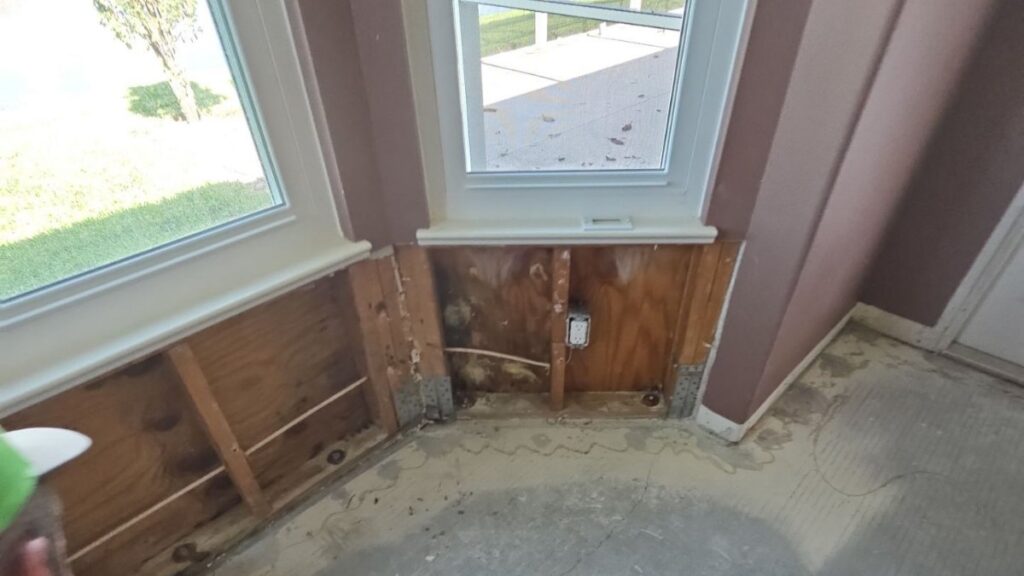
Drywall is paper over gypsum. Once contaminated water wicks up into it, there’s no cleaning the inside of that paper. You can dry it, and it’ll look fine for a while, but the bacteria and the smell are still in the wall. So on gray and black water we do a flood cut: we remove the bottom 2 feet or the bottom 4 feet of drywall, depending on how high the water has wicked up the wall by the time we get there.
Those two heights aren’t random. Drywall comes in 4-foot-wide sheets, so a cut at 2 feet or 4 feet lines up with a standard sheet and makes the rebuild cleaner for whoever puts the wall back. (We don’t do the rebuild. We’ll connect you with contractors we trust.)
If there’s insulation behind the drywall and it’s wet, it comes out too. Wet insulation holds contaminated water against the framing and never dries on its own. The baseboards, trim and door casings that the water touched come out with it. We use the same 2- or 4-foot cut if a clean water job isn’t drying and we have to open a wall on day three, so the finished edge is the same either way.
Before the cut and after the cut, the area gets treated with an antimicrobial. On dirty water we treat multiple times, not once, because the goal isn’t to make it look clean. It’s to make the framing and the slab safe to close back up.
Why we never run fans on dirty water
On a clean water job, air movers are the workhorse. We set roughly one per wall up to 12 feet, so four or five in a bedroom, with a dehumidifier pulling the moisture out of the air and a HEPA air scrubber running even on clean losses.
On gray or black water, we don’t run air movers at all. Just dehumidifiers and air scrubbers. The reason is simple: blowing air across contaminated, wet materials spreads bacteria through the air in your home. You’d be aerosolizing whatever was in that water and pushing it into the hallway, the bedrooms and the return vent of your AC. The dehumidifier still pulls moisture out of the room, and the air scrubber filters what’s in the air, but nothing is blowing across the contamination until it’s gone.
That gives you a simple test. If a company ever sets up fans on a dirty water or mold job before the contaminated materials come out, stop the work and call a professional for a second opinion. That’s not how it should be done, and it’s the single most common shortcut we clean up after.
The same rule applies to mold. We never run air movers on mold.
What comes out, and what happens if we find mold
On gray and black water, normally every finish the water touched comes out: flooring, baseboards, trim, doors, drywall and insulation. Carpet and pad that would have been saved on a clean leak go too, because there’s no way to get sewage out of a carpet pad. Cabinets and vanities are usually particle board, which soaks contaminated water up and won’t let it go, so the bottoms of those often come out as well.
Everything that comes out is bagged and taken out through the shortest path we can set up, with floor protection down so the rest of the house stays clean. What stays, the framing, the slab, the block, gets cleaned, treated and dried until it reads at the dry standard we took from an untouched wall in your house.
Sometimes we open a wall on what started as a clean water job and find mold already growing behind the baseboard. When that happens we stop, set up containment around that area to keep it from spreading to the rest of the house, and treat that section like a black water loss: cut out and treated with antimicrobial. At that point we also recommend having a licensed mold assessor look at the property. We don’t do mold testing ourselves. In Florida the company removing the mold shouldn’t be the one testing it, because that’s a conflict of interest, and we’d rather you have an independent set of eyes on it.
At the end of the job you get the full package: the moisture readings, every photo we took along the way, the estimate and the invoice. If there’s an insurance claim, that’s the documentation your adjuster needs to see why the drywall came out instead of being dried. Every policy is different and we can’t promise what yours will cover, but we can make sure the reason is on paper.
Quick answers
Is a washing machine overflow gray or black water? Gray. It’s used water with soap and whatever was in the clothes, and it needs the flood cut, not drying in place.
Is a toilet overflow black water? Yes. Water from a toilet bowl is grossly contaminated, so we treat any toilet overflow as black water, the same as a sewer backup. A leaking supply line to the tank is clean water, but anything that comes out of the bowl is black.
Is storm water black water? Yes. By the time it comes in under your door it has crossed the yard and the street, and we treat it like sewage.
Why did you cut 4 feet instead of 2? Because the water had wicked higher than 2 feet by the time we metered it. The 2- and 4-foot heights line up with standard drywall sheets so the rebuild is cleaner.
Can’t you just dry it and spray it? Not on gray or black water. Contaminated drywall, pad and insulation can’t be cleaned from the inside, and running fans on it spreads the contamination through the house.
Will my house smell? Once the contaminated materials are out and the area has been treated, the smell goes with them. The dehumidifiers and air scrubbers run until the readings say dry.
Does insurance cover a sewage backup? Every policy is different. Some cover it under the main policy, some need a separate endorsement, and some don’t cover it at all. We document everything so you and your adjuster are working from the same photos and readings.
Why Brevard homeowners call us
We’re a small-town company, and we’re proud of our Brevard roots. We treat our customers like family, not like a number, and we take care of every home like it’s our own. We’ve never worked for an insurance company. On a claim, we work for you, the homeowner, because working for the insurer too would be a conflict of interest. We aim to do it right the first time, so you shouldn’t need to call us back unless something new happens. And honestly, we just like making a bad day a little better, even if it’s only by lending a hand.
Dealing with a toilet overflow, washer backup or storm water? Call Affordable Water and Mold Removal at (321) 890-2512 for a free moisture evaluation. We serve all of Brevard County, from Mims to Palm Bay and the beaches.
About the author: Daniel Ryan Townsend grew up in Port St. John and has spent 15+ years in the restoration field, starting in his early twenties as a helper for a Brevard County restoration company. He worked his way up from technician to lead tech, supervisor, and management, then opened Affordable Water and Mold Removal in March 2018. He has been IICRC certified for 10+ years and holds the WRT (water damage restoration) and AMRT (mold remediation) certifications, plus Florida mold remediator license MRSR3317.
Recent Posts
Will Insurance Cover Your Water Damage in Florida?
What Florida policies often push back on after a leak (the 14-day rule, $3,000 mitigation caps, mold) and how we back up your Brevard claim.
What Causes Most Water Damage in Brevard County Homes
AC drain overflows, supply lines, slab leaks and backed-up drains. A Brevard restoration owner on the leaks we see most and how to catch them early.
Mold Behind the Kitchen Cabinets: A Titusville Drain Leak Job, Start to Finish
A slow drain leak under a Titusville kitchen sink turned into mold behind the cabinets and wall. Here is how the job ran, with photos, from containment to hand-off.