
Contents
We walked into a home in Malabar recently and found mold around every single supply vent in the house. Not one room. Every room. Dark rings around the registers, staining creeping across the ceiling, and that heavy, sticky feel the second you step inside.
No pipe had burst. No roof was leaking. The water feeding all that mold was coming out of the air.
If you’re seeing mold around your AC vents, here’s what we found, what the numbers told us, and why cleaning the vents alone won’t fix it.
What the meters showed
We took readings two ways: once with the AC cooling, and once with the AC off and the fan still running.
| Condition | Temperature | Relative humidity | Dew point |
|---|---|---|---|
| AC cooling | 75.6°F | 69.6% | about 65°F |
| AC off, fan ON | 70.0°F | 85.8% | about 65.5°F |
In a healthy Florida home you’d want humidity under 60%, and ideally closer to 50%. This house was at nearly 70% with the AC running, and close to 86% once the compressor shut off.
The number that tells the real story is the dew point. The house got cooler, but the dew point didn’t drop at all. It actually went up a hair. That means the AC was cooling the air without pulling much water out of it.
We also watched the system run. It cooled for about 7 to 8 minutes, shut off, and the fan kept blowing.
Why the humidity stays high: short cycles and a fan left ON
Your AC has two jobs. It cools the air, and it pulls water out of it. The cooling happens fast. The drying takes time.
When the system kicks on, the indoor coil needs a few minutes to get cold enough for water to start condensing on it. Then that water has to build up and drip into the drain pan. If the system shuts off at 7 or 8 minutes, it’s barely started drying the house before it stops.
That usually points to one of a few things:
- The system is oversized for the house. A unit that’s too big cools the room fast, satisfies the thermostat, and shuts off before it dehumidifies.
- The thermostat is getting fooled. If it sits near a supply vent or in a draft, it thinks the house is cool when it isn’t.
- Something is shutting the unit down early. Low refrigerant, a dirty coil, or a safety switch tripping can all cut cycles short.
- Leaky ductwork or returns. A return that pulls in hot attic or garage air keeps feeding moisture into the house.
Then there’s the fan. With the thermostat fan set to ON, the blower keeps running after the compressor stops. All the water sitting on that wet coil gets blown right back into the house. That’s exactly what our fan-only reading showed: humidity jumped to almost 86%.
Why the mold shows up right at the vents
The air coming out of your supply vents is usually somewhere around 55°F. In this house, the air in the rooms had a dew point of about 65°F.
Think of a cold glass of iced tea on the porch. When the surface is colder than the dew point, water beads up on it. Every time the AC ran, the metal registers and the ceiling right around them got colder than the room’s dew point and started to sweat.
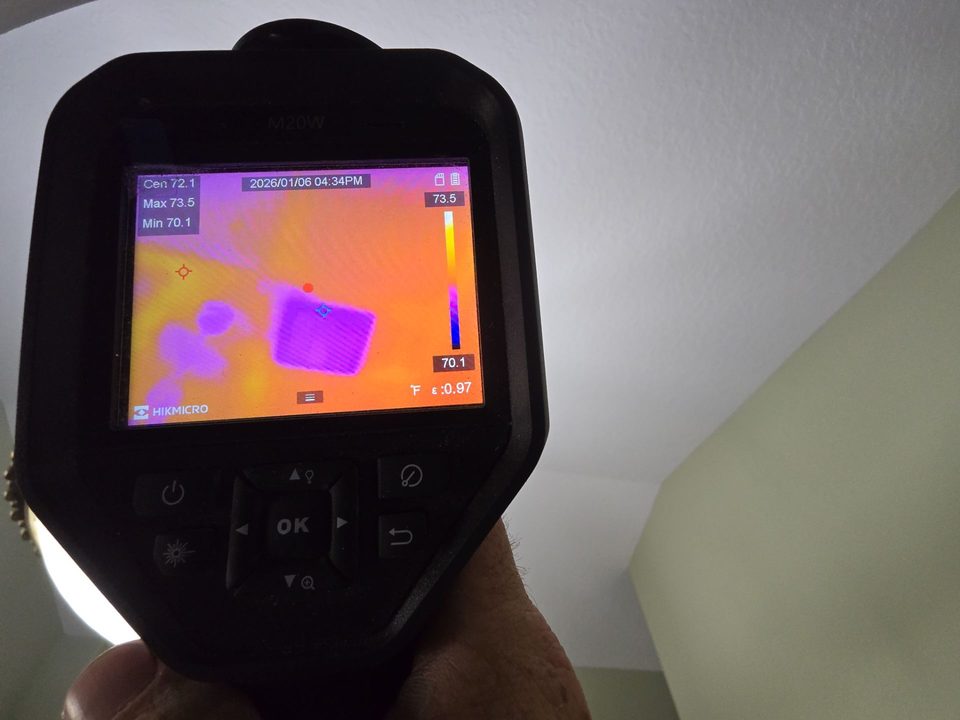
Wet drywall plus dust plus Florida humidity is all mold needs. Our thermal camera showed the cold rings around each register clearly, and the mold followed the same pattern. When it’s at every vent in the house, the cause is almost always the air, not a leak.
The other thing that makes a vent sweat is a vent that isn’t sealed to the drywall. In this house the humidity was the main problem, but it’s worth having the seal around each vent checked too.
What to do if you have mold around your AC vents
- Set your thermostat fan to AUTO today. It costs nothing, and it stops the blower from putting water back into the house after every cycle.
- Pick up a cheap hygrometer. If your indoor humidity sits above 60%, you have a moisture problem whether you see mold yet or not.
- Call a licensed HVAC company. Ask them to check whether the system is sized right for the house, look at the refrigerant charge and airflow, and inspect the ductwork and returns for leaks. If the unit is oversized and replacing it isn’t in the budget yet, ask about adding a dehumidifier.
- Don’t just wipe the vents. Bleach on the registers makes them look better for a few weeks. If the humidity doesn’t come down, the mold comes right back.
- Get the mold handled the right way. Once the HVAC side is sorted out, the affected materials need to be properly remediated.
On a job like this, we handle the mold remediation and clean the ductwork, then fog it with an antimicrobial. A licensed HVAC company takes care of everything inside the unit itself, like the coil and blower. An independent mold assessor does the clearance at the end, so you know it’s actually done.
The order matters. If we remediate before the humidity problem is fixed, you’re paying to clean up mold that will grow right back.
Seeing mold around your vents in Brevard County?
We’ll come out, inspect the mold, take humidity and moisture readings, and tell you straight what’s causing it. The moisture evaluation and consultation are free.
Affordable Water and Mold Removal, Inc. serves all of Brevard County, from Mims to Palm Bay and the beaches, including Malabar and Palm Bay, Monday through Friday, 8 to 5. We’re IICRC certified and licensed in Florida for mold remediation (MRSR3317).
Call (321) 890-2512 or request a free inspection.
About the author: Daniel Ryan Townsend grew up in Port St. John and has spent 15+ years in the restoration field, starting in his early twenties as a helper for a Brevard County restoration company. He worked his way up from technician to lead tech, supervisor, and management, then opened Affordable Water and Mold Removal in March 2018. He has been IICRC certified for 10+ years and holds the WRT (water damage restoration) and AMRT (mold remediation) certifications, plus Florida mold remediator license MRSR3317.
Recent Posts
Mold After a Leak in Viera: Why a Newer Home Isn’t Immune
Newer Viera homes still get mold after a leak. Where leaks hide, what to do in the first 48 hours, and how mold remediation works. Free mold inspection.
Burst Pipe in Melbourne? Call a Plumber or a Dry-Out Company First?
Burst pipe in Melbourne? Shut off the main, call a plumber to fix the pipe and a dry-out company to stop the damage. Free moisture evaluation, Mon–Fri 8–5.
Flooded in West Melbourne or Palm Bay? What FEMA Says About Your Cabinets, Tile Floors and Showers
After the November 2 flood in West Melbourne and Palm Bay: what FEMA says about wet cabinets, tile floors, showers and drywall, what flood insurance pays for, and what to do in the first 48 hours.