Contents
Every time a storm spins up in the Gulf or the Atlantic, the whole Space Coast starts watching the cone. Most of the time Brevard gets lucky. But hurricane season doesn’t end until November 30, and the time to get ready is before there’s a storm on the map.
You can find storm prep lists all over the internet. This isn’t another generic one. It’s what we’d add as a water damage and mold company, from what we see in Brevard homes after storms come through.
Before the storm
Plan on losing power for days
After a storm around here, we usually see multiple days without power. Be ready for it. Have a generator on standby if you can, and never run it inside your home or garage.
No power also means no AC, and your AC is what keeps the humidity down inside your house. If you lose power for a few days in Florida heat, the house gets damp fast. Once the power’s back, get the AC running again right away.
Sandbag the doors you know leak
If you’ve got a doorway that lets water in during a heavy rain, it’s going to leak in a storm. Sandbag it ahead of time to keep water from coming in under the door.
Take photos and a walkthrough video of your whole property
This one costs nothing and can save you a lot of headaches with your insurance company. Before the storm hits, photograph everything:
- Outside: your landscaping, the outside walls, your roof, and your vehicles in the driveway.
- Inside: anything that touches the floor, like tables, desks, chairs, entertainment centers, and cabinets.
The easiest way to do it is one slow walkthrough video of the whole property, inside and out. If you end up with damage, you’ll have proof of what everything looked like before.
After the storm
Document everything again
Once it’s safe to look around, take the same photos and video again. What got damaged? Did water get into your home? Did any trees come down in your yard? Did branches or hail scratch your vehicle in the driveway? These are always good things to have on record, and your before-and-after photos together make your claim a lot easier.
Call your insurance company, and be patient
If you do have damage, call your insurance company, and they’ll schedule an adjuster as soon as they can. Just remember that after a big storm they may have tens of thousands of claims at once, so it can be a slow process. Be patient with everyone you’re dealing with. Everybody has a lot going on and is stressed out, and we know you are too.
One thing worth knowing: many policies exclude leaks that have been going on for 14 days or more, so report water damage promptly. Every policy is different, so check yours or ask your agent what’s covered.
If water got inside
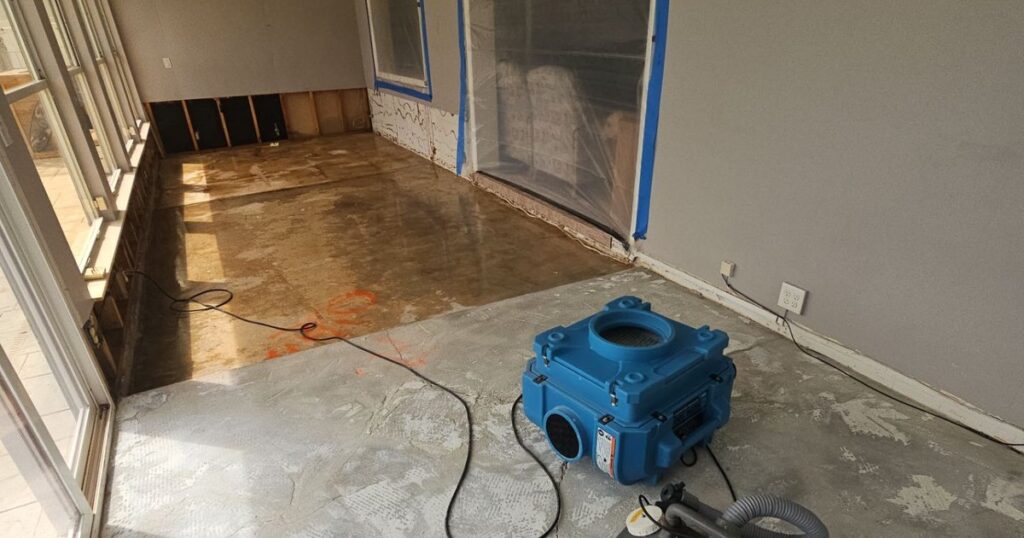
Don’t wait on the adjuster to start drying. Water keeps soaking into drywall, cabinets, and the slab the whole time it sits, and mold can start growing within 24 to 48 hours.
- Storm water from outside is treated as black water. It’s contaminated, so don’t mop it up yourself and don’t point a fan at it. Blowing air across contaminated, wet material spreads bacteria through the air in your home. On these jobs we cut out the bottom 2 or 4 feet of drywall and remove anything the water touched. We explain why in gray and black water: why we cut drywall and never use fans.
- Keep the house closed up. It feels like opening the windows should help, but Florida’s outside humidity usually runs 60 to 80%. Once the power’s back, keep everything shut and let your AC run.
- Watch for roof leaks. If a roof leak is still dripping, get buckets under it and call a roofer for a patch or temporary repair. We help our customers find reputable local roofers with emergency service.
Be careful who you let in after a storm
The biggest thing we see locally is companies coming in from out of town: Orlando, Fort Pierce, Fort Lauderdale, even New Smyrna. Often they’re the insurance company’s preferred vendors. Too often, their techs don’t know where water hides in a house, and they leave it wet. Then we get the call for the mold. That happens when the mitigation isn’t done right in the beginning, and it means more headaches and a longer timeline for you.
A few things to know before you sign with anyone:
- You can usually choose your own company. Your insurance company may try to send its preferred vendor, a company that works for them, not you. Check your policy.
- Ask who they work for. We’ve never worked for an insurance company. On a claim, we work for you, the homeowner.
- Ask how they’ll know it’s dry. We take a “dry standard” reading on a wall the water never touched and dry the rest of your house back to it.
Pick the right company first.
Quick answers
What should I photograph before a hurricane? Everything, inside and out: the roof, outside walls, landscaping, your vehicles, and anything inside that touches the floor. One slow walkthrough video is the easiest way.
Is storm water that gets inside dangerous? Treat it as contaminated. Don’t mop it up yourself and don’t point a fan at it.
Do I have to use the restoration company my insurance sends? You can usually choose your own. Check your policy or ask your agent.
How fast can mold grow after storm water gets in? It can start within 24 to 48 hours.
Why Brevard homeowners call us
We’re a small-town company, and we’re proud of our Brevard roots. We treat our customers like family, not like a number, and we take care of every home like it’s our own. We’ve never worked for an insurance company. On a claim, we work for you, the homeowner. We aim to do it right the first time, so you shouldn’t need to call us back unless something new happens.
Storm water get inside? Call Affordable Water and Mold Removal at (321) 890-2512 for a free moisture evaluation. We serve all of Brevard County, from Mims to Palm Bay and the beaches.
About the author: Daniel Ryan Townsend grew up in Port St. John and has spent 15+ years in the restoration field, starting in his early twenties as a helper for a Brevard County restoration company. He worked his way up from technician to lead tech, supervisor, and management, then opened Affordable Water and Mold Removal in March 2018. He has been IICRC certified for 10+ years and holds the WRT (water damage restoration) and AMRT (mold remediation) certifications, plus Florida mold remediator license MRSR3317.
Recent Posts
Mold Around Every AC Vent? The Problem Usually Isn’t a Leak
Mold on every supply vent? We found 70–86% humidity in a Malabar home. Here’s why short-cycling AC causes it and what fixes it for good.
Mold After a Leak in Viera: Why a Newer Home Isn’t Immune
Newer Viera homes still get mold after a leak. Where leaks hide, what to do in the first 48 hours, and how mold remediation works. Free mold inspection.
Burst Pipe in Melbourne? Call a Plumber or a Dry-Out Company First?
Burst pipe in Melbourne? Shut off the main, call a plumber to fix the pipe and a dry-out company to stop the damage. Free moisture evaluation, Mon–Fri 8–5.