
Contents
Every week somebody tells us the same thing on the phone: “It’s okay, the floor is tile, so it’s fine.” Then we get there, put a meter on the slab next to the wet wall, and the floor isn’t fine at all.
Tile itself doesn’t soak up water. That part is true. But in Brevard County almost every house sits on a concrete slab, and the slab, the thinset and the grout lines all hold water like a sponge. Once water gets under the tile, the tile stops being a floor and starts being a lid. It traps the moisture in the concrete, where it can sit for weeks and feed mold in the baseboards and drywall above it.
This post walks through what actually happens to each kind of floor after a leak, which ones we can usually save, and why tile is the one that surprises people. If you’ve got water on the floor right now, call (321) 890-2512 first and read this later.
Why water under tile means the tile has to come up
When water gets under tile, it’s sitting in the thinset and in the top of the slab. Concrete can only release that moisture upward, and tile is glazed, so there’s nowhere for it to go. You can run dehumidifiers over a tile floor for a week and the slab underneath will barely move.
The only way to dry the slab is to pull the tile so the concrete can release the moisture. We don’t say that lightly, because pulling tile is loud, dusty and expensive, and it means a rebuild later. But leaving a wet slab under tile is how a small leak turns into a mold job three months down the road, when the baseboards start to blacken and the room smells musty every time the AC kicks off.
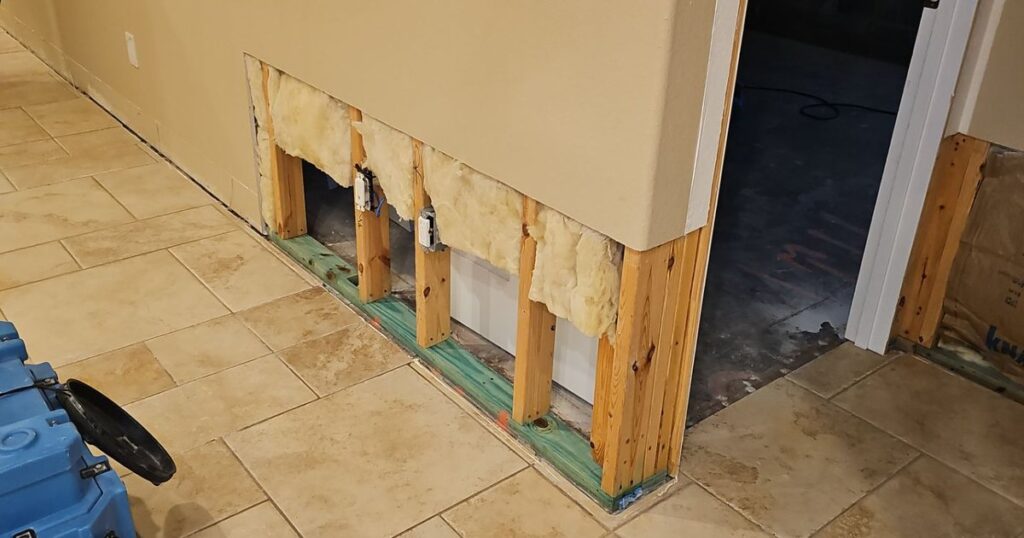
How does water get under tile in the first place? Usually through the edges. Water runs across the tile, hits the wall, and wicks down behind the baseboard into the gap between the tile and the drywall. From there it spreads sideways under the floor. It also gets in through cracked grout, through the toe-kick under cabinets, and through any spot where the tile meets a different floor. A supply line under a kitchen sink can wet the slab under half the kitchen without a single tile ever looking wet from the top.
That’s why we don’t trust our eyes on a tile floor. We meter it.
Floor by floor: what we can usually save
Every job is different, and the category of water matters more than the floor type (more on that below). But here’s how it usually goes on a clean water leak, which is most of what we see.
Carpet. This is the good news. On a clean water loss we can normally save the carpet itself. The pad underneath is a different story. Pad is foam, it never dries in place, and it’s cheap to replace, so it comes out. We pull it, extract and dry the carpet, dry the slab under it, and the carpet goes back down on new pad.
Luxury vinyl plank (LVP). LVP is waterproof vinyl, and the planks themselves are fine. The problem is what’s under them. When water gets underneath LVP, it has to come up so the floor below can dry. In theory the planks could be reused. In practice the click-lock tabs usually break when they come apart, so most of the time it can’t go back down.
Laminate. Laminate isn’t vinyl, even though it looks like it. It has a fiberboard core, and fiberboard swells the moment it gets wet. The edges lift, the seams bubble, and it usually can’t be saved. If your laminate floor has been wet for more than a few hours, plan on replacing it.
Wood floors. We dry them as far as we can, and we can usually get them dry. But there’s normally some damage left behind, like cupping or warping, and a wood floor that’s been wet for days may need sanding or replacement once it’s dry. The faster we get drying equipment on it, the better the odds.
Tile. The one everybody thinks is safe. If the water stayed on top, we extract it and dry the room, and the tile is fine. If the water got underneath, the tile has to come up so the slab can release the moisture. We’d rather pull a few square feet of tile now than remediate a moldy wall later.
Gray or black water changes everything. Any toilet overflow, a drain or sewage backup, or storm water from outside isn’t a drying job. Normally every finish the water touched comes out: flooring, baseboards, trim, doors, drywall and insulation. That includes carpet that would have been saved on a clean leak. We explain the water categories in gray and black water: why we cut drywall and never use fans.
How we decide what stays
We don’t guess, and we don’t go by how a floor looks. On the first visit the techs walk the whole area with moisture meters and a thermal imaging camera. The camera shows us where the water went, which is almost always farther than the wet spot you can see. The meters tell us how much moisture is in each material.
Then we take a reading on a wall the water never touched. That’s our dry standard, the number for your house, and it’s what we dry everything back to. We’re not chasing a textbook number. We’re matching your own home.
On a clean water loss, day one is extraction, pulling pad and baseboards, and setting equipment. Day two we come back and check every reading. Day three is the day to be meticulous. If a floor or a wall isn’t drying on schedule, that’s when we add equipment, cut drywall, pull cabinets, or pull the tile, because by that point we can’t treat it as a clean water loss anymore. Day four is normally our last day, and anything still wet on day four gets treated as black water and has to come out.
That four-day clock is why a fast start matters so much. The sooner the slab is open and drying, the more of your floor survives.
What you can do in the first hour
- Shut the water off at the main if you can do it safely. If it’s a roof leak, get buckets under the drips.
- Kick off wet shoes before you leave the wet area. Tracking water through the house spreads it farther than you’d think.
- Move furniture off the wet floor, or get the legs up on foil or blocks. Pull rugs and anything cardboard off the floor.
- Keep the AC running. Opening the windows feels right, but outside humidity in Brevard runs 60 to 80 percent, and your AC is the better dehumidifier.
- Don’t start pulling up flooring or cutting drywall yourself. We need to see it to document it, and your insurance company will want to see it too.
The mistake we see most is mopping up what’s visible and calling it done. Most of the moisture has already wicked into the drywall, the baseboards and the slab by then, and mold can start growing within 24 to 48 hours of a leak. A free moisture evaluation takes less time than you’d spend wondering.
Quick answers
Is tile waterproof? The tile is. The grout, thinset and slab under it are not. If water gets under the tile, the slab can’t dry until the tile comes up.
Can you dry a tile floor without pulling it? If the water stayed on top, yes. If it got underneath, no. We’ll meter it and show you the readings before anything is pulled.
Can carpet be saved after a leak? On a clean water loss, usually yes. The pad underneath comes out and gets replaced.
What about vinyl plank? It has to come up so the floor under it can dry, and the click-lock tabs usually break on the way out.
Laminate? It swells and almost never survives.
Does insurance cover a new floor? Every policy is different, and we can’t promise what yours will pay. What we can do is document the moisture readings and photos so your adjuster sees exactly why the floor had to come up.
Why Brevard homeowners call us
We’re a small-town company, and we’re proud of our Brevard roots. We treat our customers like family, not like a number, and we take care of every home like it’s our own. We’ve never worked for an insurance company. On a claim, we work for you, the homeowner, because working for the insurer too would be a conflict of interest. We aim to do it right the first time, so you shouldn’t need to call us back unless something new happens. And honestly, we just like making a bad day a little better, even if it’s only by lending a hand.
Call Affordable Water and Mold Removal at (321) 890-2512 for a free moisture evaluation. We serve all of Brevard County, from Mims to Palm Bay and the beaches.
About the author: Daniel Ryan Townsend grew up in Port St. John and has spent 15+ years in the restoration field, starting in his early twenties as a helper for a Brevard County restoration company. He worked his way up from technician to lead tech, supervisor, and management, then opened Affordable Water and Mold Removal in March 2018. He has been IICRC certified for 10+ years and holds the WRT (water damage restoration) and AMRT (mold remediation) certifications, plus Florida mold remediator license MRSR3317.
Recent Posts
Mold From a Failing AC: Titusville Humidity Mold Remediation, Before and After
No leak, no flood. A malfunctioning AC let the indoor humidity climb in this Titusville home until mold started growing. Here is the cleanup.
AC Drain Line Leak Behind the Return: Rockledge Mold Remediation, Before and After
A hidden AC drain line leak in a Rockledge home ran long enough to become a Category 3 water loss with mold. Here is what we found, what came out, and what the closet looked like when we were done.
A Pipe Leak That Ran Through the Walls: Melbourne Water Damage Restoration, Before and After
A pipe leak inside the walls of a Melbourne home meant drywall down to the studs. Here is what was behind the baseboards, the drying setup and the clean result.