
Contents
Water’s coming through your ceiling, and it isn’t your leak. It’s coming from the unit upstairs. Now you’ve got a stain spreading across the ceiling, maybe wet carpet or baseboards, and a neighbor you might barely know.
The first thing most people ask us is whose insurance pays for this. The answer surprises a lot of condo owners: you still start with your own.
Leaks from the unit above coming down into our customer’s unit are the most common thing we see in condos. Here’s how it usually works in Florida, and what to do while you wait for help.
You claim on your own policy, even when it’s the neighbor’s leak
Your insurance is there to protect your home, so you make the claim with your own insurance company. If it sees fit, it can go after your neighbor’s insurance, or your neighbor, to get its money back. That’s called subrogation.
A lot of our customers don’t realize they still have to claim on their own policy when a neighbor caused the damage. And while everybody sorts out whose fault it was, the water in your ceiling and walls isn’t waiting. Mold can start growing within 24 to 48 hours of a leak.
Every policy is different, so check yours or ask your agent what’s covered.
Your condo policy vs. the association’s
In Florida, the association’s insurance covers the drywall and everything inside the wall. Your condo policy covers from the texture out: flooring, baseboards, texture, paint, cabinets, and your personal belongings.
So on a ceiling leak, the association’s side would normally cover replacing the ceiling drywall, but the texture and paint on it fall on your policy. That split comes from Florida Statute 718.111(11)(f), and this Florida condo law firm’s article walks through an example just like it.
Every association is different too. Check your own policy and your association’s documents for the details.
Who we work for on a condo job
We work for the owner of the unit we’re working in, even if the neighbor’s unit caused the damage. You’re our customer, and we always try to keep your best interest in mind.
We also work with condo associations and property managers, and we’ve worked on a lot of condos. So we know how many people can end up looking at one leak: you, your neighbor, the association, and each of their insurance companies.
That’s why we document everything the way insurance companies want it, and on insurance claims we write our estimates in Xactimate, the same software their adjusters use. We can’t promise what anyone’s insurance will pay, but our documentation is built to back up your claim. More on that on our insurance claim documentation page.
We contract directly with you, the homeowner, so at the end of the day the bill is yours, even if insurance doesn’t pay for some reason. On most of our insurance claims, we also refer a public adjuster to help our customer get everything their policy covers.
What to do while you wait for us
- Get the leak upstairs stopped. Nothing dries while water’s still coming through.
- Get anything valuable or irreplaceable out of the wet area, like family photos, keepsakes, and important papers.
- Move anything breakable out of the way.
- Don’t track water through the rest of your unit. Your shoes are soaked, and every trip spreads it further. Kick them off before you leave the wet area.
- Keep the doors and windows closed and let your AC run. Outside humidity here usually runs 60 to 80%. Your AC works like a dehumidifier and pulls moisture out of the air better than outside air ever will.
One more thing: find out where the water came from upstairs. If it came from their toilet, treat it as black water, even if it looks clean. Don’t mop it up yourself and don’t point a fan at it. Here’s why we cut drywall and never use fans on gray and black water.
For the rest, here’s what to do right after water damage, and the mistakes that make it worse.
What we look for when the water came from above
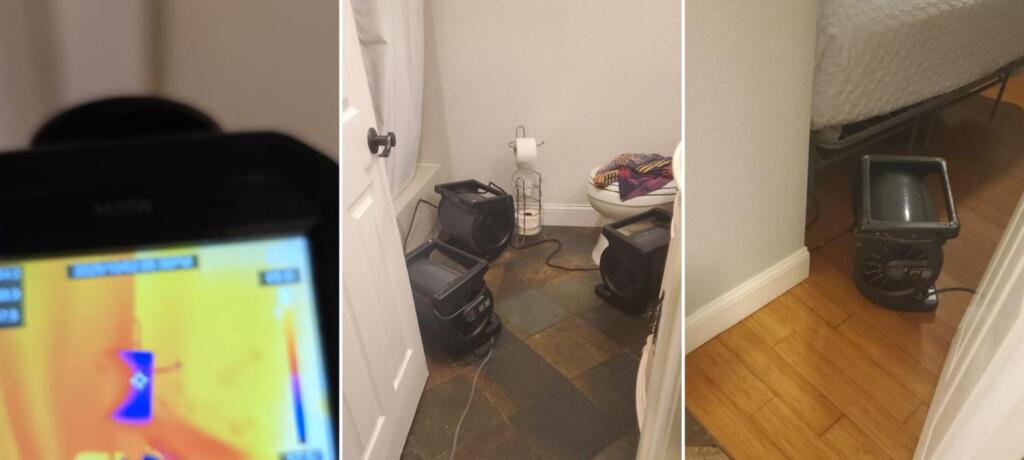
We start by documenting everything and figuring out what’s wet and how wet it is. Thermal imaging cameras show us where the water went, and moisture meters tell us how much is in the materials. We find out where the water came from, how clean it is (the category), how much got wet (the class), and whether it’s still leaking or already fixed.
A ceiling stain is just the part you can see. When we walk a unit, we’re also looking for baseboards pulling away from the wall and cabinets swelling at the bottom. Cabinets and vanities are usually particle board, which soaks water up and won’t let it go. And if there’s insulation behind wet drywall, it comes out too.
To know when it’s actually dry, we find a wall in your unit that the water never touched and take a “dry standard” reading. That’s the number we dry the rest of your unit back to. Most dry-outs take three to four days.
Once it’s dry, you’ll usually have missing baseboards and holes in the drywall. We’ll connect you with drywall and finish carpentry contractors we trust to put everything back.
Mold in condos
On the mold side, we see heavy contamination in condos from a lack of moisture control, like not running the AC. If you’re not living in the unit, a dehumidifier is a great tool for preventing mold.
The best mold prevention there is? A dry home.
Quick answers
Who pays when the condo above leaks into mine? You make the claim with your own insurance company. If it sees fit, it can go after your neighbor’s insurance to get its money back. That’s called subrogation.
Does the condo association’s insurance cover water damage in my unit? In Florida, the association’s insurance covers the drywall and everything inside the wall. Your condo policy covers from the texture out. Check your policy and your association’s documents.
Who does the restoration company work for if my neighbor caused the leak? With us, the owner of the unit we’re working in. That’s you.
How fast can mold start after a ceiling leak? It can start growing within 24 to 48 hours.
Why Brevard homeowners call us
We’re a small-town company, and we’re proud of our Brevard roots. We treat our customers like family, not like a number, and we take care of every home like it’s our own. We’ve never worked for an insurance company. On a claim, we work for you, the homeowner, because working for the insurer too would be a conflict of interest. We aim to do it right the first time, so you shouldn’t need to call us back unless something new happens. And honestly, we just like making a bad day a little better, even if it’s only by lending a hand.
Water coming through your ceiling from the unit above? Call Affordable Water and Mold Removal at (321) 890-2512 for a free moisture evaluation. We serve all of Brevard County, from Mims to Palm Bay and the beaches.
About the author: Daniel Ryan Townsend grew up in Port St. John and has spent 15+ years in the restoration field, starting in his early twenties as a helper for a Brevard County restoration company. He worked his way up from technician to lead tech, supervisor, and management, then opened Affordable Water and Mold Removal in March 2018. He has been IICRC certified for 10+ years and holds the WRT (water damage restoration) and AMRT (mold remediation) certifications, plus Florida mold remediator license MRSR3317.
Recent Posts
Water Behind a Bathroom Vanity: Rockledge Water Damage Mitigation, Before and After
The vanity in this Rockledge bathroom looked normal from the front. The wall behind it did not. Here is how the job went, from floor protection to a dry wall.
The AC Drained Into the Garage Ceiling: Melbourne Mold Remediation, Before and After
An upstairs AC drain line backed up in a Melbourne home and the water ended up in the garage ceiling. Here is the mold we found, the tear-out and the clean result.
Mold From a Failing AC: Titusville Humidity Mold Remediation, Before and After
No leak, no flood. A malfunctioning AC let the indoor humidity climb in this Titusville home until mold started growing. Here is the cleanup.