
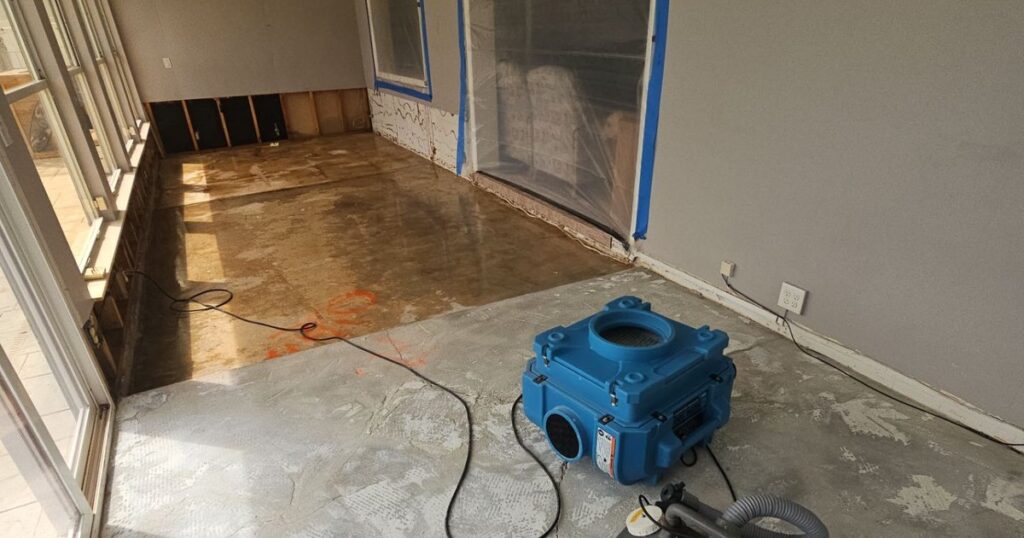
On Monday, November 2, the National Weather Service office in Melbourne declared a flash flood emergency for West Melbourne and Palm Bay, its most serious flood alert. By Monday night the Weather Prediction Center had measured 20.60 inches of rain in Palm Bay and 24.10 inches in Malabar, close to Florida’s single-day record. Airboats pulled residents out of flooded homes in the Wingate subdivision, police reported homes flooded along the Hollywood Boulevard corridor, the I-95 ramp at Palm Bay Road went under, and the governor declared a state of emergency for Brevard and six other counties.
If water came into your house this week, you are now looking at wet cabinets, a tile floor that looks fine but may not be, and a shower wall you are not sure about. This post goes through what FEMA actually says about each of those, what the National Flood Insurance Program pays for, and what to do in the next 48 hours. We are a Cocoa company and we work West Melbourne and Palm Bay every week, so this is written for the homes here: slab foundations, tile floors, drywall over wood or metal studs, and a lot of particleboard cabinets.
First, the clock: FEMA’s 24-to-48-hour rule
FEMA’s mold guidance is blunt: “Dry your home and everything in it as quickly as possible – within 24 to 48 hours if you can.” Anything soaked by floodwater that cannot be cleaned and dried completely in that window should be taken outside, and FEMA says that includes building materials, not just belongings. The reason is mold. There is a second reason that matters for your wallet: standard National Flood Insurance Program policies do not cover mold damage. The adjuster pays for the water damage. Nobody pays for the mold that grew because the house sat wet for a week.
That is why FloodSmart, the flood program’s own site, tells you to document first and start cleanup right away instead of waiting: take clear pictures and video of everything before you clean, fix or throw it out, write down the serial numbers on appliances, keep small samples of damaged materials for the agent (a piece of carpet, a square of laminate, a chunk of baseboard), and save every receipt. We cover the paperwork side in more detail on our insurance claim documentation page.
Safety comes before any of it. Floodwater is not rainwater. FEMA and the Red Cross describe it as carrying “mud, silt, and unknown contaminants” that are a health hazard, and in this part of Brevard it has been through septic drainfields, lift stations and parking lots on its way into your house. We treat it as Category 3 black water, the same category as sewage, and that changes what can be saved. Turn off the power and gas before you go in, wear gloves and an N-95, and keep generators outside.
What “flood damage-resistant” means to FEMA
FEMA’s Technical Bulletin 2, updated in January 2025, is the rulebook for what builders may use below the flood level in a flood zone. It defines a flood damage-resistant material as one that can sit in floodwater for at least 72 hours and come out needing only cosmetic repair: cleaning, sanitizing, sanding, repainting. Everything else is rated unacceptable, and FEMA lists the reasons: the material soaks up and holds water, it contains wood or paper that falls apart, its glue dissolves, or it stops the material behind it from drying.
The bulletin is written for new construction, but it is also the most honest answer you will get to the question every flooded homeowner asks: can this be saved? If FEMA will not let a builder put it below the flood line, it is because it does not survive a flood.
Cabinets
FEMA’s rating: built-in cabinets made of wood or particleboard, unacceptable. Metal cabinets, acceptable.
Almost every cabinet box in a West Melbourne or Palm Bay kitchen is particleboard with a thin veneer. Particleboard swells within hours. The bottom shelf bows, the toe kick crumbles, and the back panel holds water against the drywall behind it. Plywood boxes hold up better, and if the water was only an inch or two deep and gone in a few hours, a plywood cabinet can sometimes be dried in place.
The FEMA and Red Cross repair guide’s first-aid advice is simple: open every cabinet door, pull the drawers (they may stick from swelling, so do not force them), and open up the back of the cabinet so air can move through. On a job we go further. The toe kicks come off, we meter the cabinet floor and the wall behind it, and a cabinet that has swollen or shows growth comes out so the wall cavity can dry. A cabinet that reads dry and is still solid stays.
For your claim: flood insurance building coverage specifically includes “permanently installed cabinets, paneling and bookcases,” so photograph the cabinets from the front and from inside, with the doors open, before anything comes out. We do not replace cabinets. That is your cabinet installer or contractor’s job after the house is dry. Our job is to make sure the wall behind them is dry and clean when they get there.
Tile floors
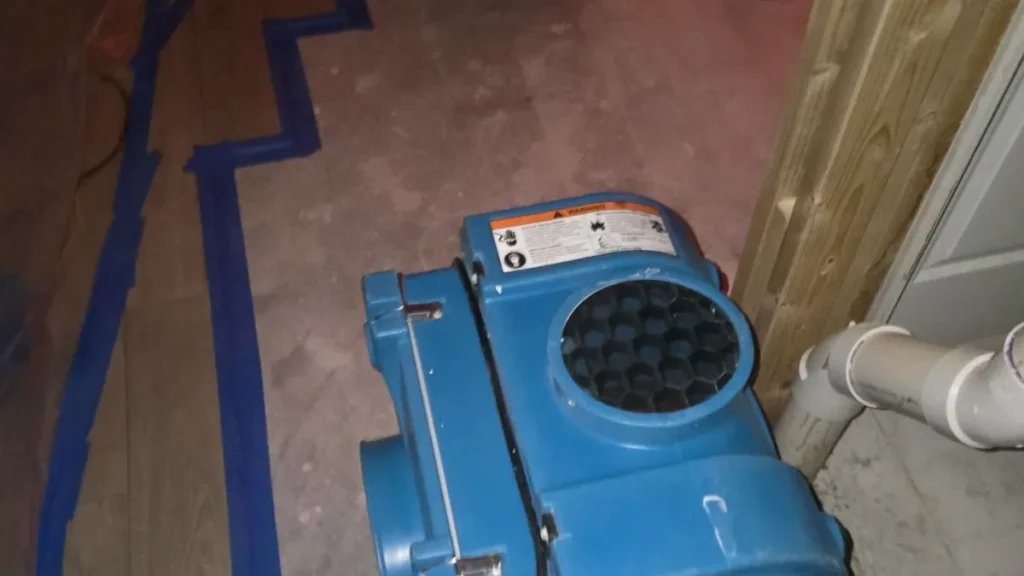
FEMA’s rating: ceramic and porcelain tile set in mortar, acceptable, on floors and walls. Tile stuck down with organic adhesive (mastic), unacceptable. Carpet, linoleum, laminate, engineered wood, solid wood, and vinyl plank with a cork or wood backing, all unacceptable.
Good news first. Most homes in West Melbourne and Palm Bay sit on a concrete slab, and tile set in thinset on a slab is exactly what FEMA calls flood damage-resistant. The tile itself will almost always survive. The trouble is everything the tile touches.
- The slab under it. Water gets through grout lines and hairline cracks and sits under the tile. A tile floor can read dry on top and be wet underneath for weeks. There is a simple check for this further down.
- The walls at the edge. Baseboards and the bottom of the drywall wick water up from the floor, which is why a dark line shows up two to six inches up the wall a few days after a flood.
- Anything that is not tile on slab. Tile on a wood subfloor (second floors, additions, some older homes) has to come up, because FEMA’s rule for material combinations says a covering that keeps the floor under it from drying is not acceptable even when the covering itself is. Laminate, vinyl plank with a wood or cork backing, carpet and pad all come out, and the FEMA and Red Cross guide says to keep a piece of each so the adjuster can see what it was.
The IICRC’s water damage standard, the ANSI/IICRC S500, comes at the same floor from the other direction. FEMA rates the material; the S500 rates the water. It calls grossly contaminated floodwater Category 3, and for Category 2 and 3 losses it says remediation comes before drying. In practice that means the tile and grout get detergent-cleaned and rinsed before any equipment runs, and the floor gets metered and thermal-imaged for water trapped in the thinset underneath. Tile that maps dry stays. Where contaminated water is confirmed under the tile, IICRC instructors teach that the grout and any loose tiles come out so the slab can be cleaned, and tile over a wood subfloor comes up entirely. The IICRC’s own 2026 position statement adds that storm water is not automatically Category 3. The restorer has to inspect and make that call on each house, which is part of what the free evaluation is for.
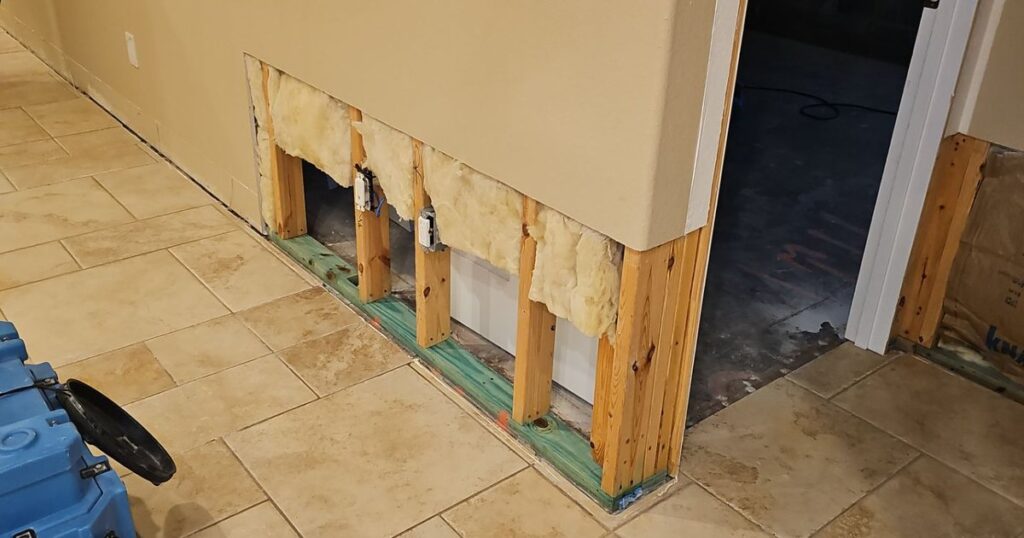
What we do: moisture-map the slab with a meter, pull the baseboards, make flood cuts where the drywall is wet, and run air movers and dehumidifiers until the slab and the framing read dry. On a tile floor that usually means days of equipment, not hours. Our water extraction page explains the equipment side.
Showers and tubs
FEMA’s rating: tile set in mortar, acceptable. Cement board and fiber-cement board behind it, acceptable. Paper-faced drywall, greenboard and plaster, unacceptable. Fiberglass batt insulation inside the wall, unacceptable.
So the answer depends on what is behind the tile. A tiled shower built on cement board, the way newer homes are built, usually comes through a flood with a cleaning and new caulk. A tiled tub surround on greenboard, common in homes from the 1980s and 1990s, is a different story. The FEMA and Red Cross guide is specific: greenboard “may be more sturdy when wet than regular wallboard. However, if soaked with floodwaters, it will present the same health hazard as regular wallboard and should be replaced.”
Fiberglass and acrylic tub-and-shower units wipe down fine. The problem is what is behind and under them. Floodwater goes under the tub apron and through the floor-to-wall joint into the cavity behind the unit, where there is often no drywall at all, just studs and insulation. That cavity does not dry on its own. It is the same place we find mold on slow tub leaks across Brevard, and a flood fills it in an afternoon.
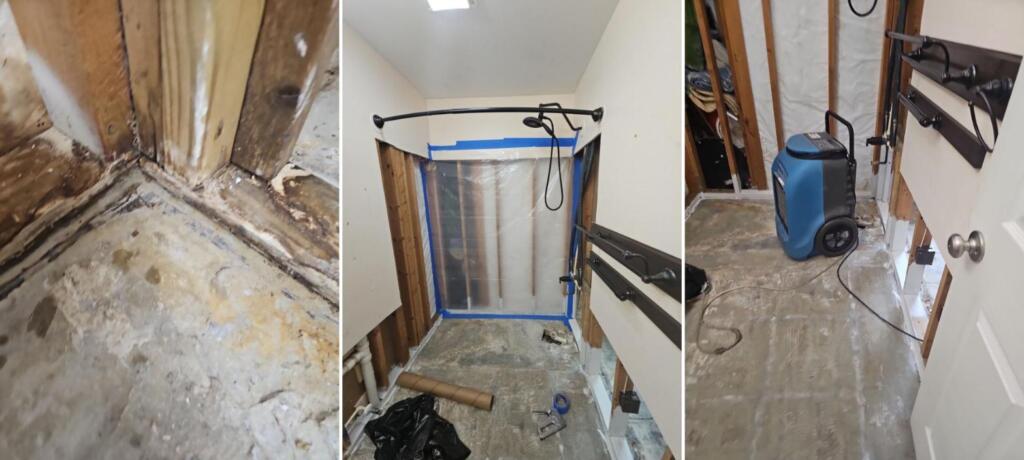
What we do: pull the trim plates around the valve and the access panel if there is one, meter the wall behind the plumbing, and open the wall from the dry side, the adjoining bedroom or hallway, rather than tearing out a sound shower.
Drywall, baseboard and insulation
The FEMA and Red Cross repair guide gives the rule most people have heard a version of: if floodwater soaked the wallboard at least four feet up, take it all down and replace it; if the water was less than four feet deep, remove the lower four feet. If there is wet insulation behind it, the wallboard has to come off to get the insulation out. FEMA’s materials bulletin backs that up by rating paper-faced drywall, fiberglass and cellulose insulation, and wood baseboard and trim all unacceptable.
On our jobs that becomes a flood cut: the drywall comes off to a clean line above the water mark, wet insulation comes out, the framing is cleaned and dried, and the wall stays open until the meter says it is dry. We do not fan-dry black-water drywall and leave it in the wall. Our flood damage restoration page walks through the whole process.
What flood insurance pays for
If you carry a National Flood Insurance Program policy, building coverage pays for flood damage to permanently installed cabinets, paneling and bookcases, permanently installed carpeting, the electrical and plumbing systems, the water heater, built-in appliances like the dishwasher, and the structure itself, up to $250,000. Contents coverage is separate, up to $100,000. It does not pay for mold, for temporary housing, or for anything outside the building.
A standard homeowners policy does not cover rising water at all; we explain the difference in Will insurance cover your water damage in Florida? If you have no flood policy, document everything anyway. The state of emergency is in place, and if it becomes a federal disaster declaration, the FEMA assistance application will ask for the same photos and lists.
A tip for West Melbourne and Palm Bay homeowners
Before anyone paints or lays new flooring, run the FEMA and Red Cross moisture check. Dry an 18-inch square of the wall near the floor, or of the bare slab, with a blow dryer. Tape a piece of clear plastic over it and seal all four edges. Check it 24 hours later. Beads of water on the underside of the plastic mean the material is still wet, no matter how dry it looks. In the guide’s words, things look dry on the surface long before they are dry on the inside.
Questions we are getting this week
Can’t I just run fans and open the windows? FEMA does say to use fans and dehumidifiers once the power is safe, and they help. But fans dry surfaces, and floodwater sits inside things: under tile, inside particleboard, in insulation, behind the tub. The materials FEMA rates unacceptable do not dry in place in 48 hours, and black water in drywall is a health problem, not a drying problem.
Do I have to wait for the adjuster before I tear anything out? No. FloodSmart says to photograph and video everything, keep samples, and start. Flood policies do not cover mold, so every day the house sits wet is damage you pay for yourself.
Flooded in West Melbourne or Palm Bay? Call (321) 890-2512
Affordable Water and Mold Removal is an IICRC Certified Firm and a Florida-licensed mold remediator and mold assessor, based in Cocoa and working across Brevard County since 2018. We come out, meter the floors and walls, photograph everything for your claim, and tell you straight what has to come out and what can stay. The moisture evaluation is free. Our hours are Monday through Friday, 8 to 5. We handle the water, the removal of wet material and the mold; when the house is dry and documented, your contractor takes it from there. Call (321) 890-2512.
Sources
- FEMA Technical Bulletin 2, Flood Damage-Resistant Materials Requirements (January 2025), Tables 1 and 2.
- FEMA and American Red Cross, Repairing Your Flooded Home (FEMA 234).
- FEMA, Prevent Mold From Becoming a Secondary Disaster.
- FloodSmart (National Flood Insurance Program), Document damage and start clean up and What’s covered.
- ANSI/IICRC S500 Consensus Body, Position Statement: Category of Water Damage and Weather-related Events (Feb. 10, 2026), quoting the 2021 S500; Patrick Moffett, How to Detect and Dry Water Trapped Between Ceramic Floor Tile, Thinset and Concrete Slab, Restoration & Remediation (Dec. 2025).
- Spectrum News 13, Heavy rain floods roads, strands drivers and damages homes across Brevard County (Nov. 2, 2026); The Watchers, Florida declares emergency after catastrophic flooding in southern Brevard County (Nov. 3, 2026); ABC News, Florida county nears state’s rainfall record (Nov. 2, 2026).